|
In 1988, Chicago's clubs were still pumping with the dance innovation that had exploded in the city two years earlier - house music. Meanwhile, at a Polish bar near the centre of town, the germ of another sonic revolt was taking shape. In front of a tiny crowd, a lanky, moon-faced guitarist and his ice-cool, American Japanese sidekick were whipping up a maelstrom of freeform jazz-punk noise. |
 18
months later, this embryonic two-man show had evolved into the Smashing
Pumpkins, a proto-grunge quartet with two incendiary 7"s to their name,
including one on the legendary Sub Pop label. Signing to Virgin (Hut in
the UK), they quickly transformed from a dizzying provincial attraction
into one of the world's biggest alternative rock bands, mixing a barrage
of metallic guitar with touches of psychedelia and jazz dynamics. Their
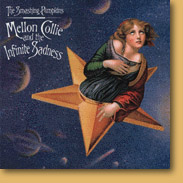
last outing - the 'White Album'-esque "Mellon
Collie And The Infinite Sadness" - has become the biggest selling double-CD,
while their total record sales have now topped the 10 million mark. |
| But global success has exacted its price. Thanks to the mercurial temperament of Billy Corgan, the group's creative mainspring, the atmosphere within the group has been fraught at the best of times. Yet the: group faced its greatest crisis last summer, when their touring keyboardist, Jonathan Melvoin, fatally OD'd on heroin in a New York hotel room. With him was Pumpkins drummer Jimmy Chamberlin, who awoke from his own drug-induced stupor to alert paramedics to Melvoin's critical condition. |
| A
close friend of Corgan's and in some respects the Pumpkins' emotional anchor,
Jimmy was fired soon afterwards for his continuing drug use. In one fateful
night, the Pumpkins lost two well-loved members, and pretty much all their
self-confidence. The years of relentless gigging, emotional upheavals and
creative peaks and troughs had finally taken their toll. But don't worry,
the Pumpkins will be soon back ...
Billy Corgan's introduction to music came early. Brought up in the suburbs of Chicago, he was the son of an R&B musician who earned a living by touring with minor showcase bands. The family house was filled with the classic sounds of his father's extensive record collection - Hendrix, Miles Davis, Frank Sinatra, Muddy Waters -- which Corgan duly absorbed. |
| Corgan's birth date of 17th March 1967 was just four weeks after that of Kurt Cobain, a man who would become his friend and occasional rival, and whose life would display several uncanny parallels to his own. As with the Nirvana singer, Billy had a disruptive home-life, being shunted from step-parent to parent and back again. "That's what's at the base of this," he once confessed to Rolling Stone "I feel like I was fucked over. I thought, why the fuck did you have me if you weren't going to take care of me?" |
| At 14, Billy was sent to psychiatrist by his stepmother (then divorced from his natural father), who believed he suffered from a persecution complex. As the shrink was one of his stepmother's best friends, he found it hard to explain that he thought she was the problem. Music proved his only escape; and after seeing a neighbour playing electric guitar in his garage, he resolved to be a rock star. At this time, Billy was enormously influenced by Judas Priest, Cheap Trick, and the Cure. Deeply intelligent and academically bright, it was assumed that Corgan would pursue a career in law, but after leaving school, he got a job in a record store. Now living with his father, who taught him "the difference between ego and true playing", he began road-testing his talents as a guitarist with a local rock band called the Marked - so called because both Billy and the drummer had strawberry birthmarks (Corgan's is on his hand) about which they'd been hugely self conscious as kids. |
| In 1987, the Marked moved to St. Petersburg, Florida in an attempt to escape the Goth-metal atmosphere of Chicago's indie scene. But within a year Billy was back home, penniless, sick and disillusioned. His answer to his predicament was to-lock himself away, to demo an astonishing torrent of original material. When he emerged he met James Iha, a strikingly handsome JapaneseAmerican, then playing in a college band called Snake Train. Sharing Corgan's musical vision of a modern Zepp/Floyd/Queen hybrid, the two began performing as a due, their first appearance taking place at one of Chicago's many Polish clubs. |
| In
1988, Corgan fell into argument outside the city's Avalon Ballroom with
D'Arcy Wretzky. A year his junior, 19-year-old
D'Arcy was classically trained musician from Michigan, who'd played with
a French group while travelling around Europe. UI went around to his (Billy's)
house because be said he was looking for people to write with," she later
explained. "But he said, 'Before we can write together you have to learn
these songs.' And he handed me a tape of 40 or 50 songs. Of his! Every
week there'd be ten more new songs. But I really loved the music." As a
trio, the Pumpkins ("It could have been any vegetable,"- Billy would wearily
point out) performed to 50 people at the Avalon with a drum machine for
back-up. They then punted a demo to the manager of the Cabaret Metro, Chicago's
biggest venue, who said he'd book them as support act if they employed
a human drummer.
Corgan called up Jimmy Chamberlin, the son of another jazz and R&B musician. Following an successful opening slot with Jane's Addiction, the Pumpkins became the Metro's premier indie support act, propping up bills featuring That Petrol Emotion and Buzzcocks. With their squalls of guitar noise, ethereal vocals and jazz dynamics, they soon became a live attraction in their own right, capable of pulling a local crowd of around 800. |
 Around
this time, a demo fell into the hands of Mike Potential, from Chicago indie
Limited Potential. He didn't like it, but was ecstatic about their live
show, which he thought he'd check out just in case". The result was a limited
7" featuring "I Am One" (now rated
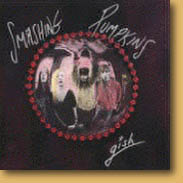
at £150+) a song later re-recorded on the debut album; "Gish". This in turn brought them to the attention of Bruce Pavitt and Jonathan Poneman of the seminal American hardcore independent, Sub Pop, who offered to put out a second single. (The label bad, of course, done exactly the same for Nirvana a year earlier.) "Tristessa" epitomised the early grunge sound, its barbed-wire guitars sparring with Chamberlin's powerhouse drumming, while Corgan's whispering, nasal voice articulated a profound sense of dislocation and loss. It was more a thrilling statement of anger and frustration, and no one could doubt the group's awesome potential. In late 1990, the Pumpkins were perhaps I the hottest unsigned rock act in America, and with the Andy Gershon/Raymond Coffer management team (Ian MacCulloch, Cocteau Twins, Love And Rockets) behind them, they inked a deal with Virgin. Work began on a debut album, "Gish" named after the silent movie heroine, Lillian Gish -- in December 1990, at producer Butch Vig's Smart Studios in Madison, Wisconsin. It was clear the group had evolved considerably, bringing in acoustic guitars and experimenting with song structure and dynamics.
In fact, with its wistful, poetic verse, gently cascading Eastern guitar riff, and thunderous Zepp-style code, "Rhinoceros" remains one of the great rock songs of the 90s, possibly eclipsing both Radiohead's "Creep" and Nirvana's "Smells Like Teen Spirit" in its schizoid beauty. Significantly, in the following months, Butch Vig went on to produce Nirvana's epochal "Nevermind"... After "Gish" was unleashed in May
1991, the Pumpkins embarked on a gruelling 18 month world tour that nearly
split them up. In September, they made their UK debut at the Camden
Underworld, which sold out despite very little press. By this time,
Billy was stepping out with Hole's Courtney Love, and Billy found that
a jealous Kurt Cobain, shadowing the Pumpkins as Nirvana's tour also hit
Europe, was penning graffiti about the couple on dressing room walls.
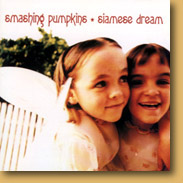
FORMULAS "He [Billy] always seemed to have these formulas in his head for what was right and wrong, good or bad," remembered D'Arcy. "I never could think that way, or see things that way. By mid-1992, though, the strain of touring was taking its toil. Jimmy was hitting the bottle, D'Arcy and James - having been an item and then splitting up - finding life in the band intolerable and Billy was slowly going mad. Matters reached a head at the Reading Festival in 1992, when a wigged-out Billy smashed up his equipment during an ill-tempered set. Halfway up the bill on the Saturday, the Pumpkins had been expected to "do a Nirvana", and liven up the event, just as Seattle's grungemeisters had done the previous year. It didn't happen- and the atmosphere of failure was compounded by the prescience of Nirvana's headlining slot the following day. Courtney, of course, was now married to Hurt. Dejected, Corgan toyed with the idea of splitting the Pumpkins. He returned to Chicago, split from his girlfriend, and entered a dark phase of self-reassessment. The pressure was on for a follow-up to "Gish", but he couldn't write. And then the inspiration came: "Today is the greatest, days of the year" went the opening lines of the song that dragged him out of the mire. It was now early 1993, and Corgan shunning his bandmates - went into Triclops Sound Studios in Atlanta, Georgia to record the album "Siamese Dream"; again with Butch' Vig at the controls.
While "Silverfuck" was a monumental axe blow-out, the later singles "Disarm" and the dreamy "Today" were sufficiently melodic and immediate to propel them chartwards, their lightness-of-touch providing a sublime counterpoint to other, more visceral crowd pleasers like the jndie-scene bashing "Cherub Rock", and "Spaceboy", written for Corgan's younger brother Jesse, who suffered from a genetic disorder.
The immense success of "Siamese Dream" - which reached No. 4 in the summer of 1993 - meant another succession of punishing tours. The album was promoted herewith an acoustic show at Raymonde's Revue Bar in Soho, before the group returned for two shows at Brixton Academy in October, during which Billy took the stage for the encore dressed as a clown. They then jetted out for more overseas dates, including triumphant homecoming gig at the Chicago Avalon, followed by a Christmas break and an appearance in January 1994 at the two-week Big Day Out festival in Australia, with Nirvana, Violent Femmes and Henry Rollins.
Between that British tour and the group's - next visit to these shores, to play the Reading Festival in August, an event occurred which had an unfathomable impact on Corgan. In April, Kurt Cobain took his own life, crushed by the contradictions of being a idealistic songwriter caught up in the enormous, cynical machinations of the music business. Corgan refused to discuss Kurt's death, but his death seemed to add a punctuation mark to the dark, self-searching days of grunge. Though Billy had cited "dysfunction" as his chief creative impulse, he- now seemed happy and relaxed, chatting to journalists about the therapy he'd had to confront the demons of his childhood. He was still wary of giving too much away, though. "After what happened to Kurt, opening up to the press seems even more ridiculous," he said. After headlining the U.S. touring festival, Lollapalooza, in July (Nirvana had been scheduled to top the bill), the Pumpkins returned to play a blinding get at Reading. With "Siamese Dream" topping critics polls the world over, the Pumpkins retired to Chicago to work on their third album, "Mellon Collie And The Infinite Sadness". Corgan had always been a prolific writer, but his new-found stability seemed to inject him with even more creative energy.
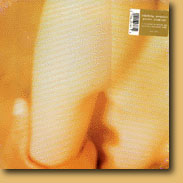
With half of the songs written on
piano, and the other half on guitar, "Mellon
Collie" ended up as a as 28 tracker, with an astonishing breath of
styles in evidence, from the lush orchestrations of "Beautiful"
(which apparently came to Corgan in a dream) to the full-on rush of "Tale
Of A Scorched Earth". The album was at its most itchingly intriguing
when Billy forsook the guitar pyrotechnics, and Either trundled along with
a lo-fi, hypnotic pop sensibility, as on In fact, it was by far the Pumpkins' most egalitarian work, with Corgan willingly loosening his creative monopoly. "I want to get the others more involved this time," he'd admitted to Melody Maker. "I want James to sing on some of it and I want D'Arcy to sing. I mean, it will still be my vision, but I want to create surroundings with it that will be conducive to their ideas too." Issued in November 1995, "Mellon Collie" proved that Corgan's vision had been as astute as ever, and the album - produced by Corgan, Flood and Alan Moulder - became their most successful to date, selling over six million copies. Yet with the success came the inevitable pressures of touring, and with that, the tragedy of Melvoin's death, and the upset of Chamberlin's dismissal. Perhaps it was the inevitable pay-off for the Pumpkins' astonishing success, the dreadful price of the kind or pressures only fame can bring. The incident occurred during the early hours of 12th July 1996, while the group were in New York to play the first of two sell-out concerts at Madison Square Garden, the scene of triumphant performances down the years by such rock myth-makers as the Rolling Stones, the Who and Prince.
"The subject [of drugs] gets so romanticised in rock'n'roll I that 'elegantly wasted' thing, James The told Mojo. "But it's totally a disastrous, selfish thing to do. We just Couldn't go on that way, trying to get around it. Basically, Jimmy overdosed every time we went on tour. What were we meant to do, lock him in his room every night?" On 27th August, the tour restarted
in Las Vegas, with replacement sticksman Matt Walker (ex-Filter) and keyboardist
Dennis Fleming (the Frogs). In September, they returned to New York to
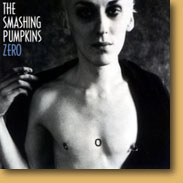
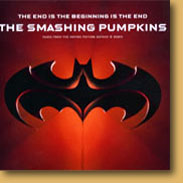
play the rescheduled Madison Square Garden dates. 18 months later, the Smashing Pumpkins have consolidated their post-Chamberlin line up, and have a new album scheduled for 1998. After a fresh mini-album "Zero", including a medley of excerpts from some hew Corgan compositions, and their Contribution to the Batman & Robin soundtrack, the chilling "The End Is The Beginning Is The End" (Teitbite), the future looks bright. In October news broke that Billy had formed a Gary Numan tribute group, the Replicants; though that same month the group were successfully sued over the death of Melvoin. But stay tuned the Pumpkins. have more fruit to bear yet. |
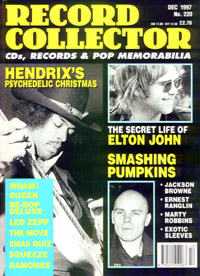 This article was printed in December 1997 (No 220) issue of Record Collector Magazine The Credits in the Record Collector article include The Smashing Pumpkins Collection and Map Records |
 If
"Gish" revealed glimpses of Billy's curious, compelling world view, then
 On
its completion, Jimmy was checked into rehab, and Billy sought professional
psychiatric help, part of a process of spiritual renewal that saw him reuniting
with his girlfriend, Chris, getting married to her, and buying a house
on Chicago's Northside.
 The
group's March 1994 British dates culminating in four :sell-out shows at
the
 Within
a few months it became clear that the album was going to be a double, possibly
even a triple. (It ended up as a two-CD and
 Melvoin
fatally overdosed on a lethal Combination of alcohol and an exceptionally
pure form of heroin, known as 'Red Rum', in his Manhattan hotel room. Chamberlin,
who was at the scene, was charged with illegal possession of a controlled
substance (a syringe with traces of heroin on it were found in the room),
and booked into a special clinic. The incident followed the death two months
earlier of a 17-year-old fan at their otherwise euphoric Dublin concert.
It was a terrible time for the group, and Billy Corgan eat back to consider
the Pumpkins' plight. Initially, he saw no other option but to await Chamberlin's
recovery, and then go straight back out on the toad. But then it dawned
on him that there as another option, far harder to take, perhaps, but ultimately
more beneficial for his precious group. He phoned the Pumpkins' manager
With these instructions: "sack Chamberlin",
 This
time, the rhythms behind the Pumpkins' incendiary guitar white-outs weren't
quite so confident, the understanding between the musicians not so intuitive.
But at least the Pumpkins were back where they should have been - at the
top.
